RRSP vs. TFSA: Where Should Your Next Investment Dollar Go?
Compare RRSP and TFSA tax benefits, withdrawals and flexibility to decide where your next investment dollar may work best within your financial plan.



Tax-Free Savings Accounts (TFSAs) are a cornerstone of financial planning for Canadians, offering unparalleled flexibility and tax advantages. However, to fully leverage their benefits, it’s essential to understand how TFSA annual contribution limits work. Misunderstanding these limits can lead to missed opportunities or penalties, so staying informed is key.
In this guide, we’ll explore everything you need to know about TFSA contribution limits, from annual limits and unused room to penalties and strategic tips for maximizing your savings.
Introduced in 2009, the Tax-Free Savings Account is a registered account designed to help Canadians grow their savings tax-free. Any income earned within a TFSA—whether from interest, dividends, or capital gains—is entirely tax-free, and withdrawals are not subject to taxes.
Eligible investments for TFSAs include:
This flexibility makes TFSAs an excellent tool for short-term goals, retirement savings, or emergency funds.
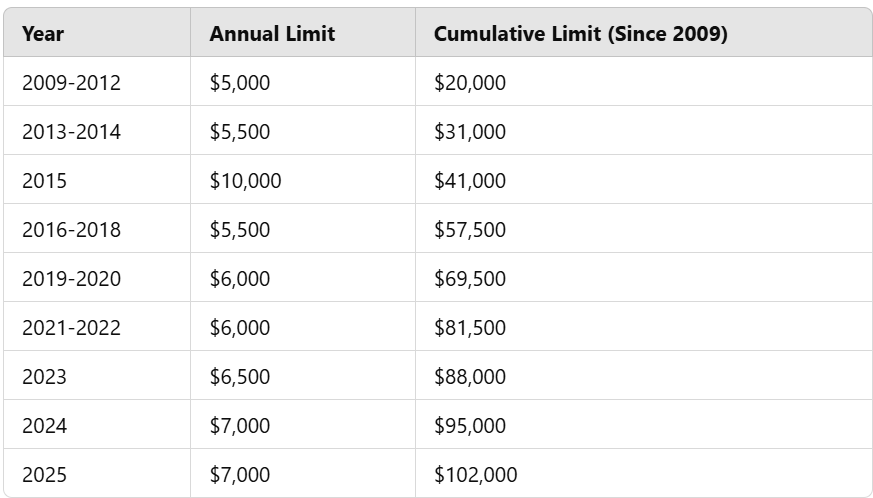
Each year, the Canada Revenue Agency (CRA) sets a contribution limit for TFSAs. For 2025, the TFSA contribution limit is $7,000. These annual limits are cumulative, meaning unused contribution room carries forward to future years.
Here’s a year-by-year breakdown of TFSA limits since their inception :For individuals who have been eligible to contribute since 2009 and have never deposited funds, the lifetime contribution room as of 2025 is $101,000.
One of the most significant advantages of TFSAs is the ability to carry forward unused contribution room indefinitely. For example, if you were eligible to contribute $6,000 in 2023 but only deposited $3,000, the remaining $3,000 would carry forward to 2024, adding to your annual limit.
To determine your total available contribution space:
Exceeding your TFSA contribution limit can result in penalties. The CRA imposes a 1% monthly tax on the excess amount until it is withdrawn or your contribution room increases in the following year.
Tracking contributions across multiple TFSAs is critical to avoid this scenario. Keeping a record of deposits and withdrawals can save you from costly mistakes.
Many people mistakenly believe that withdrawing funds immediately frees up contribution space in the same year. In reality, the withdrawn amount is added back to your contribution room only in the following calendar year.
Unlike RRSPs, TFSA contribution room is not tied to your income. Every eligible Canadian over the age of 18 receives the same annual limit.
You can open multiple TFSAs at different institutions, but the contribution limit applies across all accounts. Contributions to multiple accounts must be tracked to avoid exceeding the overall limit.
Understanding TFSA rules and contribution limits can be complex. Financial advisors play a critical role in helping you:
At Dunbrook Associates, we specialize in creating tailored financial plans to help clients maximize their TFSA benefits. Whether you’re saving for retirement, a major purchase, or an emergency fund, our expertise ensures you’re making the most of your tax-free savings.
TFSAs offer incredible advantages, but understanding the annual contribution limits is essential to unlocking their full potential. By staying informed, tracking your contributions, and consulting with financial professionals, you can avoid costly mistakes and achieve your financial goals faster.
Ready to make the most of your TFSA? Contact Dunbrook Associates today for personalized advice tailored to your unique needs.
.jpg)
Compare RRSP and TFSA tax benefits, withdrawals and flexibility to decide where your next investment dollar may work best within your financial plan.

For many Canadian homeowners, a mortgage renewal once felt like a routine piece of paperwork. The lender sent a letter, the borrower reviewed the new rate, and another term began.
.jpg)
For most investors, however, long-term investing offers a more practical path toward meaningful financial goals. Rather than trying to predict the market’s next move, a long-term strategy focuses on building a diversified portfolio, remaining invested through changing conditions, and allowing time and compounding to do much of the work.