RRSP vs. TFSA: Where Should Your Next Investment Dollar Go?
Compare RRSP and TFSA tax benefits, withdrawals and flexibility to decide where your next investment dollar may work best within your financial plan.


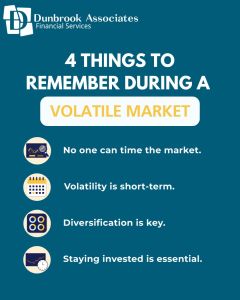
Market volatility can be unsettling, especially for investors who watch their portfolios fluctuate day to day, sometimes dramatically. Yet, these periods are a natural part of the economic cycle and can present opportunities for long-term gains when approached with patience and strategy. While it may be tempting to react impulsively during market downturns, keeping a few key principles in mind is important. Below are four critical considerations for navigating volatile markets.
The notion of perfectly timing the market — buying low and selling high — is a myth that even seasoned investors struggle to achieve consistently. Markets are inherently unpredictable and influenced by many global and economic factors, many of which are beyond anyone’s control. Attempting to time the market can lead to missed opportunities, as markets tend to recover quickly after downturns and often when least expected.
Consider this: during times of significant volatility, investors who pull out of the market to avoid further losses often find themselves missing the best days of recovery. According to historical data, a few strong days in the market can account for a large portion of the overall gains during a year. Missing out on these days can significantly diminish your returns.
Rather than attempting to time the market, focus on your long-term investment goals. It's often better to stick with a well-constructed investment plan that factors in risk tolerance, time horizon, and financial objectives. Short-term swings, no matter how wild, should not dictate your investment strategy.
When experiencing a volatile market, it’s easy to let emotions take over and start thinking the turbulence will last forever. However, it’s important to remember that market volatility is generally short-term in nature. Markets experience cycles of ups and downs and history has shown that over the long term, they almost always continue to rise.
Volatility is often driven by temporary events like political uncertainty, economic shifts, or unexpected crises. Take the COVID-19 pandemic, for instance. The markets experienced a sharp drop in early 2020, followed by a rapid recovery as businesses adapted and economies stabilized. Similar patterns have been observed during previous recessions and economic shocks.
For long-term investors, it's essential to maintain a broader perspective. While the market may seem unstable today, short-term fluctuations will likely be a blip in the bigger picture in five or ten years. Over time, the market has historically recovered and rewarded those who stay the course. By understanding that volatility is often temporary, investors can avoid rash decisions that could harm their financial future.
Diversification is one of the most effective strategies to protect your portfolio during volatile periods. It’s a risk management technique that involves spreading investments across a variety of assets, industries, and geographical locations to reduce the impact of any single downturn. The idea is that when one asset or sector is struggling, others in your portfolio may be performing well, which helps to balance out the overall risk and volatility of your portfolio.
For instance, consider a portfolio that includes a mix of stocks, bonds, and real estate. If the stock market takes a hit, the bonds or real estate investments may provide stability and cushion the blow. Diversifying internationally can also help, as different countries’ economies often perform differently under the same global conditions.
Diversifying within asset classes is also worth considering. For example, holding a range of stocks across different industries—such as technology, healthcare, and energy—can provide additional protection during market volatility. The goal of diversification is not to eliminate risk entirely but to minimize it by ensuring that your portfolio isn’t overly reliant on one type of investment.
However, diversification should be done thoughtfully. Simply holding a large number of investments doesn’t guarantee protection; the key is to choose assets that behave differently under various market conditions. A well-diversified portfolio tailored to your risk tolerance can help you weather market storms more effectively.
One of the most crucial things to remember during volatile times is that staying invested is often the best course of action. It may feel counterintuitive when you see the value of your portfolio drop, but pulling out of the market during a downturn can lock in losses and eliminate the opportunity for recovery when the market bounces back.
Historical data supports the wisdom of staying invested. Consider the aftermath of major financial crises like the 2008 Great Recession or the dot-com bubble of the early 2000s. In both cases, markets eventually rebounded, and investors who stayed the course were rewarded. While staying calm during significant market dips can be challenging, history shows that markets recover, and long-term investors tend to see positive returns.
Dollar-cost averaging can be an effective strategy during volatile periods. This involves consistently investing a fixed amount of money regularly, regardless of market conditions. When prices are low, your fixed investment buys more shares, and when prices are high, it buys fewer. Over time, this approach averages out the price you pay for investments, reducing the impact of short-term volatility and allowing you to stay invested through market ups and downs.
Another aspect to consider is the power of compound growth. The longer your money stays invested, the more time it has to grow, with earnings generating further earnings - the snowball effect. By staying invested during market dips, you're positioning yourself to take advantage of the recovery and the following compound growth.
Volatility is an inevitable part of investing, but it doesn't have to derail your long-term financial plans. Remember, no one can time the market, and periods of volatility are typically short-lived. Get help from a financial planner at Dunbrook Associates to diversify your portfolio and help mitigate risk, and keep you invested through the ups and downs. By keeping these four principles in mind, you can confidently navigate volatile markets and stay on track toward your financial goals.
.jpg)
Compare RRSP and TFSA tax benefits, withdrawals and flexibility to decide where your next investment dollar may work best within your financial plan.

For many Canadian homeowners, a mortgage renewal once felt like a routine piece of paperwork. The lender sent a letter, the borrower reviewed the new rate, and another term began.
.jpg)
For most investors, however, long-term investing offers a more practical path toward meaningful financial goals. Rather than trying to predict the market’s next move, a long-term strategy focuses on building a diversified portfolio, remaining invested through changing conditions, and allowing time and compounding to do much of the work.