RRSP vs. TFSA: Where Should Your Next Investment Dollar Go?
Share
For Canadians deciding where to invest next, the choiceoften comes down to two familiar accounts: the Registered Retirement SavingsPlan (RRSP) and the Tax-Free Savings Account (TFSA). Both can shelterinvestment growth from annual taxation, both can hold investments such asmutual funds, exchange-traded funds, stocks, bonds and GICs, and both cansupport a long-term financial plan. Yet they do not provide the same taxtreatment or the same flexibility.
The best place for your next dollar is not determined bywhich account is “better” in isolation. It depends on your tax rate today, thetax rate you may face later, your goal, your timeline, your need for access tothe money and how each account fits with your other income. In many cases, thestrongest strategy uses both accounts in a deliberate order.
How an RRSP Works
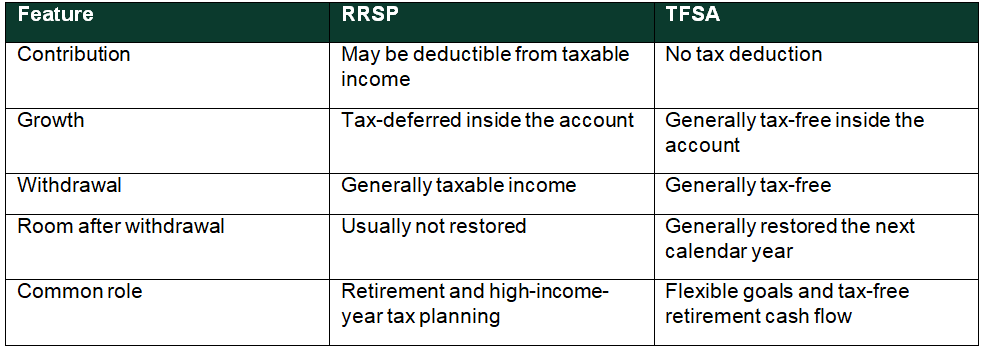
An RRSP is designed primarily to encourage retirementsaving. Eligible contributions can generally be deducted from taxable income,subject to your available RRSP deduction limit. That deduction may reduce theincome tax you owe for the year or increase your refund. Investments then growtax-deferred while they remain inside the account.
The tax is postponed rather than eliminated. Withdrawals aregenerally included in taxable income in the year they are taken, and thefinancial institution normally withholds a portion at the time of withdrawal.The central opportunity is a difference in tax rates: receiving a deductionwhen your marginal rate is relatively high and withdrawing later when your rateis lower can make the RRSP especially effective.
Because RRSP decisions influence both current taxes andfuture retirement income, they should be coordinated with a broader retirement planning strategy. Contributionroom, employer pensions, expected government benefits and the timing of futurewithdrawals all matter.
How a TFSA Works
A TFSA provides a different trade-off. Contributions aremade with after-tax dollars, so they do not create an income-tax deduction.However, eligible investment income and growth inside the account are generallytax-free, and withdrawals are not included in taxable income. That can providevaluable flexibility for retirement, a home renovation, a vehicle, travel, anemergency or another goal.
When money is withdrawn from a TFSA, the amount is generallyadded back to your contribution room at the beginning of the following calendaryear. This makes the account reusable, but timing matters: replacing awithdrawal in the same year without enough unused room can cause anovercontribution. Your personal room should always be confirmed before contributing.
RRSP vs. TFSA at a Glance
When an RRSP May Deserve the Next Dollar
You are in a high tax bracket today
An RRSP contribution can be compelling when your currentmarginal tax rate is high and you reasonably expect a lower rate when the moneyis withdrawn. The immediate deduction can free up cash, but the result improveswhen the tax savings are also invested rather than absorbed into everydayspending.
Your employer offers matching contributions
If an employer matches all or part of a workplace RRSPcontribution, contributing enough to receive the full match will often be apriority. The match is an immediate benefit that is difficult to reproduceelsewhere. Plan rules, vesting and fees should still be reviewed.
Your goal is long-term retirement saving
RRSP withdrawals outside specific programs permanently usecontribution room and create taxable income, which can discourage casualspending. For investors who value structure, that friction can supportdisciplined retirement saving. RRSP assets must also be converted or withdrawnaccording to the rules by the end of the year in which the account holder turns71, so eventual income planning is essential.
You expect an unusually high-income year
A bonus, business income, capital gain or other incomeincrease may make an RRSP deduction more valuable. Available contribution roomcan also be carried forward, and a contribution does not necessarily have to bededucted in the same year. Coordinating the timing may improve the benefit.
When a TFSA May Deserve the Next Dollar
You are currently in a lower tax bracket
Someone early in a career, on parental leave, returning toschool or temporarily earning less may receive limited value from an RRSPdeduction today. A TFSA can allow tax-free growth while preserving RRSP roomfor a future year when the deduction may be worth more.
You may need the money before retirement
The TFSA is often a natural fit for goals that requireflexibility. Withdrawals are generally tax-free, and the withdrawn amount isrestored as room the following year. That does not mean short-term money shouldbe invested aggressively: the investments inside the TFSA should still matchthe goal’s timeline and your tolerance for loss.
You want greater control over taxable retirement income
TFSA withdrawals do not generally increase taxable income.This can help retirees manage cash flow without automatically increasing theincome used to calculate certain income-tested credits or benefits. Bycontrast, RRSP or RRIF withdrawals are taxable and may affect thosecalculations. A coordinated withdrawal plan can therefore be as important asthe original contribution decision.
You want to preserve flexibility later
A well-funded TFSA can serve as a tax-free reserve for majorpurchases, healthcare needs, family support or market downturns. It may allow aretiree to avoid taking an unnecessarily large taxable withdrawal in a singleyear.
The Tax-Rate Test: Useful, but Not the Whole Answer
A practical starting point is to compare your marginal taxrate when contributing with the effective rate expected when withdrawing. Ifthe future rate is lower, the RRSP tends to gain an advantage. If the futurerate is higher, the TFSA tends to become more attractive. If the rates are thesame—and the RRSP tax savings are invested—the two accounts can produce broadlycomparable after-tax outcomes under simplified assumptions.
Real life is rarely that simple. Future tax brackets canchange. Retirement income may come from pensions, government benefits, abusiness sale, registered accounts and non-registered investments. A spouse mayhave a different income profile. Large RRIF withdrawals can stack on top ofother income, while TFSA withdrawals do not. This is why account selectionbelongs within integrated tax and cash flow planning, not just a one-yearrefund calculation.
Do Not Confuse the Account With the Investment
An RRSP or TFSA is an account structure, not an investmentby itself. Either account may hold conservative, balanced or growth-orientedinvestments. Choosing the right account will not compensate for a portfoliothat is poorly diversified, too expensive or mismatched to the goal.
A sound investment planning process considers risktolerance, time horizon, asset allocation, diversification, fees and taxlocation together. It also supports the discipline described in The Benefits of Long-Term Investing Over Short-Term Trading:the account choice matters, but consistent contributions and a durable strategyoften matter even more.
Common Mistakes to Avoid
· Choosingan RRSP only for the refund. The refund is not free money; the contributioncreates future taxable income. Consider investing the tax savings and planningthe eventual withdrawal.
· Using anRRSP for money you may need soon. An unexpected withdrawal can create taxand permanently consume room. Maintain an accessible emergency fund.
· Recontributinga TFSA withdrawal too early. Unless other room is available, wait until thenext calendar year before replacing the withdrawn amount.
· Ignoringcontribution limits. Overcontributions can create penalties. Confirm yourroom using reliable records and recent account activity rather than relyingonly on a potentially delayed online figure.
· Treatingthe decision as permanent. Income, family needs and goals change. Theappropriate order of contributions can change with them.
A Practical Order for Your Next Dollar
Before choosing between the accounts, make sure theinvestment dollar is truly available for a longer-term goal. High-interest debtand an insufficient emergency reserve may deserve attention first. Thenconsider the following sequence as a planning framework, not a universal rule:
1. Capturethe full employer match, if one is available and appropriate.
2. Definethe goal and when the money may be needed.
3. Compareyour current marginal tax rate with a reasonable range of future effectiverates.
4. Reviewyour available RRSP and TFSA room and any upcoming income changes.
5. Chooseinvestments that match the goal, then automate contributions.
6. Revisitthe strategy annually and after major life, career or tax changes.
Often, the Best Answer Is Both
Many households benefit from funding both accounts. Ahigher-earning spouse may prioritize RRSP contributions while a lower-earningspouse emphasizes a TFSA. A worker may direct a bonus to an RRSP and regularmonthly savings to a TFSA. A retiree may draw strategically from registeredsavings while preserving TFSA assets for future flexibility—or use taxablefunds to contribute to a TFSA when room is available.
The right mix should be reviewed across the household andacross time. Comprehensive wealth management connects contributionchoices with investment selection, retirement income, taxes, estate goals andcash-flow needs.
Make the Decision in the Context of Your Full Plan
The RRSP-versus-TFSA question sounds like a choice betweentwo accounts, but the real question is what you need this dollar to accomplish.Is the priority a valuable deduction during peak earning years? Flexibleaccess? Tax-free retirement cash flow? An employer match? A future homepurchase? The answer can shift as your income and life evolve.
Dunbrook Associates helps individuals and families in Barrieand the Greater Toronto Area coordinate investment, tax and retirementdecisions within one long-term strategy. Rather than selecting an account basedon a rule of thumb, we assess how each contribution affects your currentposition and future options.
Disclaimer: Thisarticle is for general informational purposes only and does not constitutepersonalized investment, tax or legal advice. Registered-plan rules andindividual circumstances vary. Confirm current limits and requirements andconsult qualified professionals before acting.
Need Personalized Support?
Our team is committed to clarity, precision, and long-term guidance.
For many Canadian homeowners, a mortgage renewal once felt like a routine piece of paperwork. The lender sent a letter, the borrower reviewed the new rate, and another term began.
For most investors, however, long-term investing offers a more practical path toward meaningful financial goals. Rather than trying to predict the market’s next move, a long-term strategy focuses on building a diversified portfolio, remaining invested through changing conditions, and allowing time and compounding to do much of the work.
When building an investment portfolio, one of the most important decisions is whether to focus primarily on growth, income, or a combination of the two. Both growth investing and income investing can play a valuable role in a long-term financial plan, but they are designed to meet different needs.
July 28, 2026
Cookie Settings
We use cookies to enhance your browsing experience, serve personalised ads or content, and analyse our traffic. By clicking "Accept All", you consent to our use of cookies.

.jpg)

.jpg)