RRSP vs. TFSA: Where Should Your Next Investment Dollar Go?
Compare RRSP and TFSA tax benefits, withdrawals and flexibility to decide where your next investment dollar may work best within your financial plan.


When building an investment portfolio, one of the most important decisions is whether to focus primarily on growth, income, or a combination of the two. Both growth investing and income investing can play a valuable role in a long-term financial plan, but they are designed to meet different needs.
Growth investing generally aims to increase the value of your portfolio over time. Income investing, on the other hand, focuses on producing a more consistent stream of cash from investments. The right approach depends on factors such as your financial goals, investment timeline, income needs, tax situation, and comfort with market fluctuations.
For many Canadian investors, the answer is not choosing one strategy and completely avoiding the other. Instead, it may involve finding the right balance for each stage of life.
Growth investing focuses on assets that have the potential to increase in value. Investors using this strategy typically purchase shares of companies expected to expand their revenue, earnings, market share, or operations faster than the broader market.
Growth-oriented companies often reinvest their profits into product development, technology, acquisitions, marketing, or expansion rather than paying a large portion of those profits to shareholders as dividends. As the company grows, investors hope the value of its shares will rise.
Growth investments may include company shares, growth-focused mutual funds and exchange-traded funds (ETFs), and broad equity investments held for long-term appreciation.
The main objective is capital appreciation. In simple terms, an investor buys an asset with the expectation that it may be worth more in the future.
Growth investing can be attractive for investors who have a longer time horizon and do not need immediate cash flow from their portfolios. However, growth investments can also experience significant short-term price swings. A promising company may fail to meet expectations, an industry may lose momentum, or changing interest rates and economic conditions may affect market valuations.
Because of this volatility, growth investors need to be comfortable remaining invested through market declines. Selling during a temporary downturn may interrupt a carefully designed long-term strategy.
Income investing is designed to generate regular cash flow. Rather than relying mainly on an investment rising in price, an income investor seeks assets that make scheduled or recurring payments.
Income-producing investments may include dividend-paying stocks, government and corporate bonds, guaranteed investment certificates (GICs), real estate investment trusts (REITs), preferred shares, and income-focused funds.
The income may arrive as interest, dividends, or fund distributions. Investors can use that cash to cover living expenses or reinvest it to purchase additional assets. When reinvested, income can compound and contribute to long-term portfolio growth.
Income investing is often associated with retirement, but it is not limited to retirees. A younger investor may reinvest dividends as part of a broader wealth-building strategy, while someone approaching retirement may use income investments to reduce reliance on employment earnings.
Income investments are sometimes viewed as conservative, but the label can be misleading. They still carry risk. A company can reduce or eliminate its dividend, bond values can decline when interest rates rise, and a high distribution may not be sustainable. REITs and dividend-paying stocks can also experience substantial changes in market value.
An investment should not be selected only because it offers an attractive yield. The quality of the asset, sustainability of its payments, fees, and role within the portfolio all matter.
The clearest difference between the two strategies is their primary objective.
Growth investing seeks to build wealth through an increase in asset value. Income investing seeks to generate cash flow while also preserving or potentially growing capital. Their risks, expected return patterns, and suitability can differ.
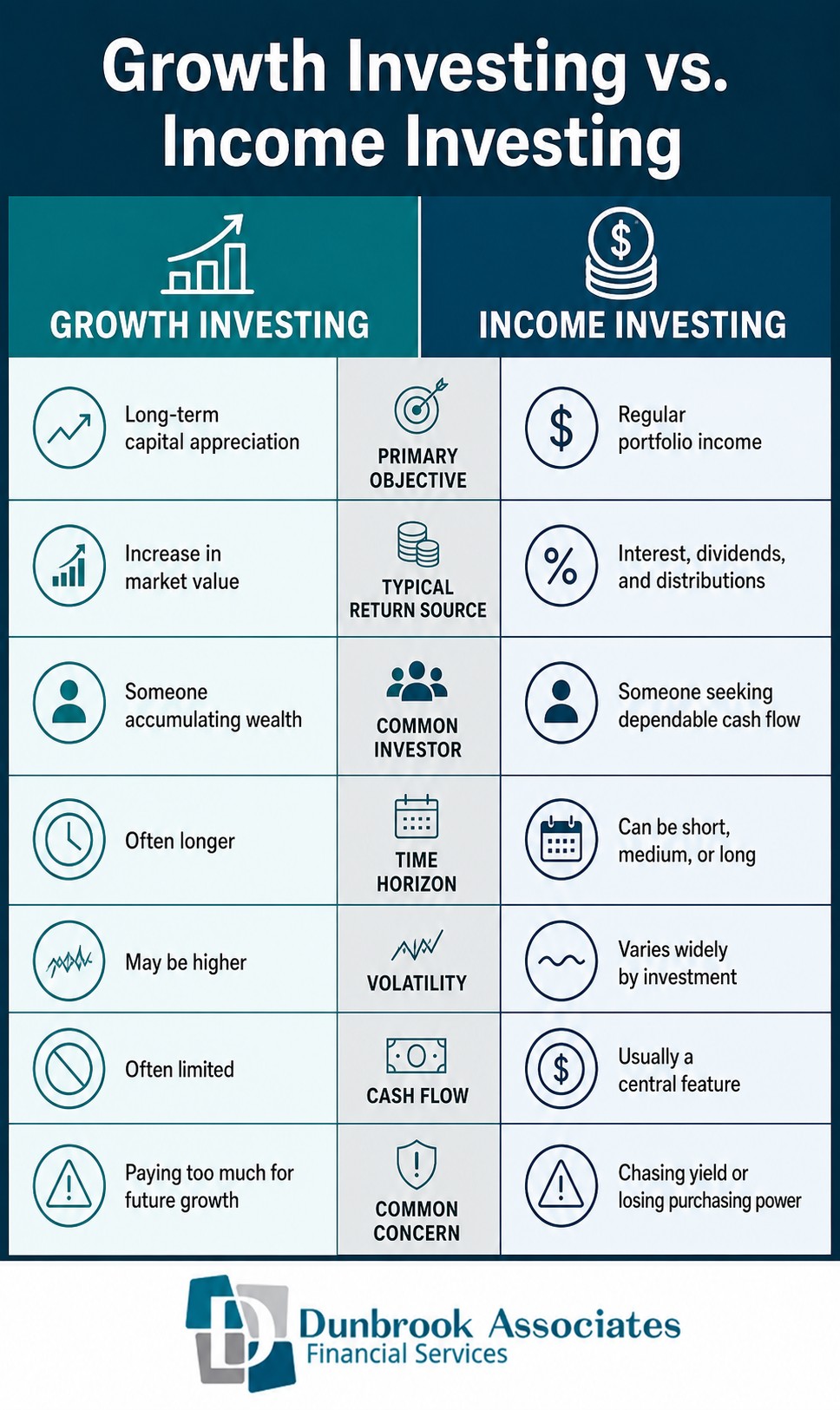
Neither column automatically represents the safer choice. A concentrated portfolio of dividend stocks may carry more risk than a diversified growth fund. A retiree with a long planning horizon may also need some equity exposure to help protect purchasing power.
The main advantage of growth investing is the opportunity for long-term wealth creation. If a company successfully expands, its share price may rise substantially. Growth assets can also help investors keep pace with or exceed inflation over a long period, although returns are never guaranteed.
Growth investing may be suitable when you:
The risks include larger price fluctuations, uncertain performance, and the possibility of overpaying for optimistic expectations. A long time horizon does not eliminate risk, so diversification remains important.
The main advantage of income investing is the potential for more predictable cash flow. Regular payments may make it easier to plan retirement withdrawals, supplement other income sources, or reduce the need to sell investments during a market decline.
Income investing may be suitable when you:
Focusing too heavily on current income can create other risks. Inflation can reduce the purchasing power of fixed payments, while a portfolio concentrated in traditional dividend sectors may lack diversification. High-yield investments may involve greater credit, business, or market risk. Total return—the combination of income and changes in market value—should remain part of the evaluation.
Taxes can meaningfully influence the amount an investor keeps. In a non-registered account, interest, dividends, capital gains, foreign income, and other distributions may receive different tax treatment. The Canada Revenue Agency requires investors to report applicable investment income, including interest, dividends, and taxable capital gains.
The right tax strategy and account selection can be just as important as investment selection. Income and gains earned within a Tax-Free Savings Account are generally tax-free, including when withdrawn, while Registered Retirement Savings Plan contributions may be deductible and eventual withdrawals are generally included in taxable income.
This does not mean every income or growth investment belongs in a particular account. The appropriate location depends on contribution room, expected return, withdrawal timeline, tax rate, and the complete financial plan. Individual circumstances vary, so portfolio design should be coordinated with qualified financial and tax professionals.
Your answer may change over time. Start by considering the following questions.
Money intended for retirement in 20 years can usually be invested differently from money needed for a home purchase in two years. Each goal should have its own timeline and acceptable level of risk.
If employment, pension, or business income already covers your expenses, immediate portfolio income may not be the priority. If you rely on investments for monthly spending, dependable cash flow and access to funds become more important.
Risk tolerance is the ability to follow your plan when markets become uncomfortable. An aggressive allocation may look appealing during strong markets but feel very different after a significant decline.
Your willingness and financial capacity to take risk are not the same. You may feel comfortable with volatility but have a short timeline that leaves little opportunity to recover from losses.
Pensions, real estate, business ownership, cash reserves, insurance, debt, and future expenses all affect portfolio design. Investments should not be planned in isolation.
Many investors benefit from holding both growth and income investments. During the accumulation years, a portfolio may lean toward growth while including bonds or dividend-paying companies for diversification. As retirement approaches, it may shift toward income and capital preservation. Even in retirement, some growth exposure may remain important because living costs can continue to rise.
A blended strategy can also support flexible withdrawals. Cash, short-term fixed income, dividends, and interest may cover near-term spending while growth assets remain invested for longer-term needs. This can reduce pressure to sell equities at an unfavourable time.
The correct mix should be based on a written financial plan not age alone. Two investors of the same age may need very different portfolios because their goals, income, health, family responsibilities, and assets differ.
Growth investing and income investing are not competing philosophies where one must win. They are tools that can be combined to serve different goals.
Growth investments may help build long-term wealth and protect future purchasing power. Income investments may provide cash flow, stability, and greater flexibility when regular withdrawals begin. The appropriate balance depends on when you need your money, how much income you require, how much market risk you can accept, and how your investments fit with your tax and retirement plans.
At Dunbrook Associates, we help individuals, families, and business owners build coordinated investment strategies around their real financial goals. Whether you are accumulating wealth, preparing for retirement, creating income from your portfolio, or reassessing your current investments, a personalized plan can help you make decisions with greater clarity.
Ready to determine the right balance for your portfolio? Contact Dunbrook Associates to discuss an investment strategy aligned with your goals, timeline, and complete financial picture.
.jpg)
Compare RRSP and TFSA tax benefits, withdrawals and flexibility to decide where your next investment dollar may work best within your financial plan.

For many Canadian homeowners, a mortgage renewal once felt like a routine piece of paperwork. The lender sent a letter, the borrower reviewed the new rate, and another term began.
.jpg)
For most investors, however, long-term investing offers a more practical path toward meaningful financial goals. Rather than trying to predict the market’s next move, a long-term strategy focuses on building a diversified portfolio, remaining invested through changing conditions, and allowing time and compounding to do much of the work.